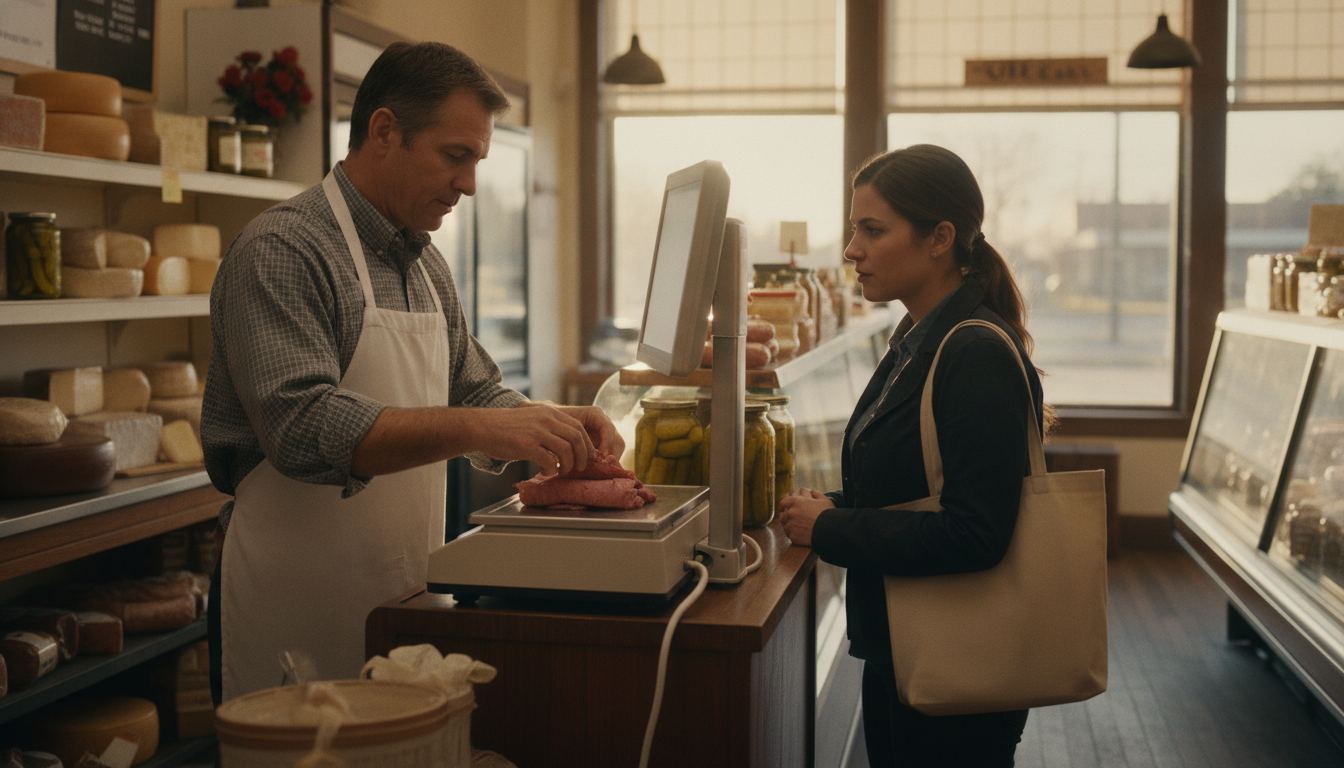
A grocery POS with a scale is a commercial weighing device talking to a cash register. It is not a nice-to-have USB gadget. If the scale sets the price the customer pays, it is legal-for-trade equipment. A produce or deli lane that cannot show net weight, unit price, and total on the ticket is not finished, even if the register rings.
The grocery buying page is grocery store POS. IT Retail’s public grocery catalog is on IT Retail POS. This page is the scale rule, not a vendor scorecard.
What NIST says a commercial scale is
NIST’s weighing FAQ, retrieved 2026-09-10 from Weighing and Scales FAQs, says commercial applications must follow the laws of the state where the device is used. It also says all 50 U.S. states have adopted NIST Handbook 44, and that the practical buying test is an active NTEP Certificate of Conformance as proof the device type meets Handbook 44. NIST OWM does not endorse brands.
A deli scale that prices meat by weight is listed there as the example of a commercial application. Before use, the FAQ says the scale must be inspected and approved by the state’s authorized weights-and-measures body. A POS vendor saying “we integrate scales” does not complete that inspection.
What the POS receipt has to print
NIST Handbook 44, 2024, Section 2.20, paragraph S.1.8.5, covers recorded representations for point-of-sale systems. For items weighed at checkout, the sales information recorded by the cash register interfaced with the weighing element must include:
- net weight
- unit price
- total price
- product class, or the product name or code number if the system has price lookup
- tare weight
That tare-weight line is nonretroactive as of January 1, 2025. If your grocerant lane still prints a total with no tare, that is the paragraph to take to the vendor and to the inspector. The source document is NIST HB 44 2024 Section 2.20 Scales, retrieved 2026-09-10.
Weight values have to be identified as tare and net, or gross if applicable, with the unit marked. Manual weight entries on a direct-sale device have their own marking rules in S.1.12. Do not key a produce weight as if it were a grocery UPC.
What to test before you buy the lane
Ask for the NTEP certificate number on the exact scale plus the POS software version. Ask whether the customer-facing weight display is in the customer’s view. Ring a weighed item with tare, a second item by UPC, and a void, then read the receipt against S.1.8.5.
A scanner scale that is legal for trade in one software build can fail after a POS update. Put the certificate and the software version in the same folder as the merchant agreement.
IT Retail’s public starter list includes scanner scales. That is a feature claim. It is not an NTEP number.
Counter Club’s published in-person sample is 2.50% plus $0.10, keyed and online 2.90% plus $0.25, with a $0 monthly fee on that sample schedule. Sample pricing applies to new accounts applying directly. Pricing is subject to underwriting, MCC and the merchant agreement; rates may differ and are subject to change. See pricing. If a grocery quote buries the scale in a bundle, send the hardware list.
Frequently asked questions
Can I put a cheap Amazon scale under the POS? Not for selling by weight. Commercial use needs Handbook 44 compliance, an NTEP certificate for the type, and a state inspection.
Does SNAP change the scale rules? SNAP still cannot charge a benefit customer more than cash. A dual-price or surcharge program on a weighed item has to follow both FNS and the scale receipt rules. Start with EBT and SNAP.
Who inspects the scale, the POS company or the state? The state or its authorized body, per NIST’s FAQ. The vendor can fail or pass that visit. They do not replace it.
Is a prepackaged 1 lb tray the same as a scale sale? Prepackaged labeled goods follow packaging rules. Items weighed at the checkout stand are the S.1.8.5 case.
Where do I find my state office? NIST links a directory of state and territory weights-and-measures offices from that same FAQ page.