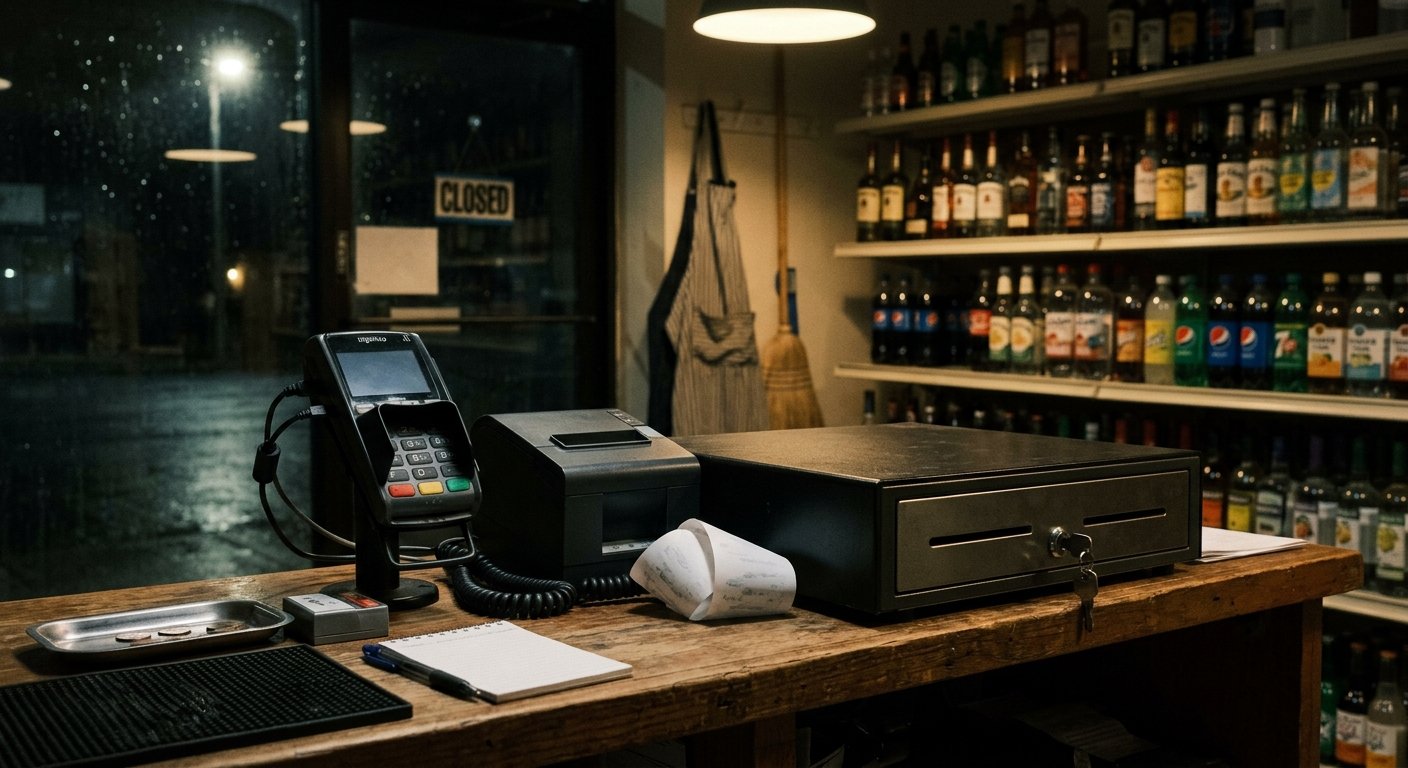
A tap at the counter is an approval, not a deposit. POS batch settlement is the register grouping those approved card tickets and sending them for funding, and that send is what starts the clock. Until the batch goes, the money sits as open tickets. A late send pushes the deposit. The sale time does not.
What POS batch settlement is at close
A batch is the day’s approved card tickets sitting together on the terminal, waiting to be sent. Each tap, dip, and swipe already got an authorization at the counter. That approval reserved the amount on the cardholder’s side. It did not move money into your account.
Close is when those tickets get packaged. The cashier counts the drawer. The register prints a tender report. The card side of that close is the credit card batch at close: sales, voids, returns, and keyed tickets grouped as one submission. The card machine end of day report is that batch tape. It is not the cash count. It is not the lottery printout from the state’s machine.
Cash still has to be counted against the drawer. That work lives on our guide to retail end of day reconciliation. A gas site has a second pile of numbers from the pumps. That work lives on gas station POS reconciliation. The batch is only the card tickets. Mixing those piles is how a close gets noisy.
A POS payment on your bank statement is rarely one bottle of whiskey. It is the funded batch, or a piece of it, landing as a deposit. One busy Saturday can be hundreds of tickets and one deposit line. A refund in the same batch nets against the sales in that send. The statement will not retell the shift story ticket by ticket.
Authorization and settlement are two different jobs. Authorization answers a simple question at the register: will this card take this amount right now. Settlement is the later send that asks the networks to move the money. Batching is how a store does that send as a group instead of as a stream of one-off captures. The twelve-dollar energy drink and the case of beer ride in the same package.
Keyed tickets belong in that package too. A phone order typed by hand is still an open ticket until it settles. So is a card that had to be punched in because the chip would not read. Leaving those sitting while the swiped sales go out is how a close looks “done” on the counter and incomplete at the bank.
How batching starts the funding clock
The deposit clock starts when the batch is sent, not when the customer tapped. That is the whole mechanism. A sale at 9:14 a.m. and a sale at 8:41 p.m. fund on the same rhythm if they ride in the same send. A sale that misses the send waits for the next one.
On accounts we board, deposits land in the merchant’s bank the next business day. Batching at the end of the day is what starts that clock, so a late batch pushes the deposit, not the sale. Weekend tickets follow business-day banking. A Friday night send and a Saturday night send do not live on the same calendar.
The cutoff is a processor and bank schedule, not a feeling. If the terminal is set to send after that cutoff, those tickets start the clock on the following cycle. The register does not get a vote. The time on the receipt does not get a vote either. Only the send time does.
When people ask when a POS batch funds, they are usually staring at an empty inbox the morning after a long Saturday. The tickets were real. The drawer matched. The batch never left, or it left after the cutoff. The account looks like it “didn’t pay.” It never got the file.
The deposit will also not match the face of every ticket. Credit card processing fees come out of that money. Card mix moves the total. A tap, a keyed number, and a rewards card are not the same cost to process. Chase a missing hundred on the batch tape first. Then read the fee line. Do not treat the bank deposit as a second cash count.
American Express may carry additional terms on some accounts. Treat that as a separate conversation with the processor, not as a surprise on a Tuesday deposit. The batch still has to go out. The funding rules around that brand sit on the merchant agreement, not on the shift report.
A store can send more than one batch in a day. A shift change is the usual reason. Each send is its own funding group and its own report. That can make the bank easier to read, or it can scatter the same Saturday across two deposit lines. Pick the pattern on purpose. Do not let it happen because someone hit settle at lunch and nobody hit it at night.
Auto-batch versus a cashier who has to hit settle
Auto-batch means the terminal closes the open tickets at a set time and sends them without a person finding a menu. Manual settle means a cashier or manager has to hit the button. Both can fund the same way. They fail in different ways.
Auto-batch fails when the clock is wrong. A 24-hour c-store does not “close.” It needs a time after the overnight rush, not a time copied from a shop that locks the door at nine. A liquor store that stays open late needs the send after the last legal sale, not at dinner. If auto-batch fires while tickets are still ringing, those later sales sit until the next cycle.
Manual settle fails when a person is tired. The drawer got counted. The alarm got set. Nobody opened the terminal menu and chose Close Batch or Settle Batch. The tickets stay open on the device. Morning looks fine until the bank does not.
A handheld and a counter terminal can each hold their own open batch. Settling the register and leaving the handheld in a charger does not send the aisle sales on that handheld. Two devices means two sends, or one host that is actually collecting both. We check that during setup. Guessing at close is how a Sunday tap never shows up.
The backup still matters on an auto-batch store. The manager should know the settle path on the device they actually use. Power blips, a frozen terminal, and a missed window are all real. The nightly send is the plan. The button is the spare tire.
Printing the batch report belongs next to the drawer count, not in a pile by the lottery terminal. The state’s lottery machine will never integrate with the register. That tape is its own close. The card batch is its own close. Stapling them together without reading them is how a mismatch hides for a week.
You can settle more than once in a day on most devices. Midday settle is a choice, not a requirement. Some owners want a clean shift handoff. Some want one send after lockup. Extra sends do not make the tickets safer. They only change how the deposits show up.
What a missed batch does to the next morning
A missed settle leaves approved tickets sitting on the terminal. The customers already left with the beer. The cardholders already see a hold or a pending charge. Your account does not. The morning deposit is short by whatever never got sent, which can be the whole day.
Staff will swear the close was done because the drawer was counted and the door was locked. Those are cash jobs. The card job is the send. If the card machine end of day report was never printed, treat the batch as unproven. A blank morning is the usual first clue. The second clue is a terminal that still shows an open batch when you unlock it.
Tickets that sit too long stay in authorization limbo. The hold on the cardholder’s side does not last forever, and a capture that never went out can fail when you finally send it. Do not turn that into a waiting game. Send the batch the same night you took the cards. If you find an open batch in the morning, settle it then. Then find out why it was still open.
A late send also wrecks the story you tell yourself about a shift. Monday’s deposit might be Saturday’s tickets. Tuesday’s deposit might be Sunday plus the late Saturday send. Payroll math gets sloppy. So does “we were slow this weekend.” You were not slow. You were unbatched.
Pump preauths at a gas site make this worse if the inside batch and the fuel captures are not both going out. The pump can look settled on the island and still be waiting to capture. Inside snacks can settle while fuel still sits. That is why the pump close and the card batch have to be read as two reports, not one vibe.
Refunds stuck in an unsent batch cause a different mess. The customer already has the return. The original sale may have funded in an earlier send. The refund is still waiting. You will see the complaint before you see the bank line. Settling daily keeps those two events on a short leash.
If the terminal cannot send, that is a line problem, a host problem, or a device problem. Standing in front of it and hitting settle again is the first move. Calling it in is the second. Leaving it until “tomorrow’s close” is how one missed night becomes three.
What we set on the terminal before it ships
We set the settle before the hardware leaves. Setup and support happen by phone, video, and shipped, pre-configured hardware, the same way we board a liquor store, a c-store, a bodega, a small grocery, or a gas site anywhere in the US. The store does not get a local tech with a different idea of close. The store gets a terminal that already knows when to send.
The first decision is auto-batch versus a person at the menu. Most counters do better with auto-batch after the last sale of the night. A 24-hour site gets a time that splits days on purpose, not a time copied from a shop that closes. We write that time down with the owner. Then we test it.
The second decision is every device. Counter terminal, handheld, spare reader if there is one. Each open batch has to have a path out. One free handheld per location ships with the sample hardware pricing on new accounts applying directly, subject to underwriting, the merchant category code, and the merchant agreement, and subject to change. A handheld that never settles still spends like a register.
The third decision is the backup. We show the manager the settle command on the actual unit they will hold at night. Menu labels differ by device, but the job does not: close the open tickets, send them, keep the report with the drawer tape. If auto-batch is on, the button is still there for a missed window.
On the published sample pricing for new accounts applying directly, the batch fee is $0.00. That sample is subject to underwriting, the merchant category code, and the merchant agreement, and it can change. Extra settles in a day are an operations choice. They are not a way we pad the statement.
We also line the batch report up with the rest of close so it does not get treated like scrap paper. Age checks, EBT split tender, and case breaks still happen on the register during the day. None of those replace the send. The send is what turns a good night of taps into a next-business-day deposit.
If you want the boarding path in one place, how it works is the walkthrough of the account, the hardware, and the remote setup. The batch time is one of the settings inside that setup. It is a small screen. It decides when your money starts moving.
Frequently asked questions
What does batch settlement mean?
Batch settlement is grouping the approved card tickets on the terminal and sending them to the processor for funding. Authorization already happened at the tap. The send is what starts the deposit clock. Until that send, the tickets are open.
How do you settle a batch on a credit card machine?
On a manual device you open the terminal menu and choose Close Batch or Settle Batch, then keep the report with the drawer tape. On auto-batch, the terminal sends at the time we set, and the button is only the backup. If a handheld rings sales, settle that unit too.
When does a POS batch fund?
On accounts we board, deposits land the next business day, and the batch send is what starts that clock. A late or missed settle pushes the deposit. The time on the customer receipt does not.