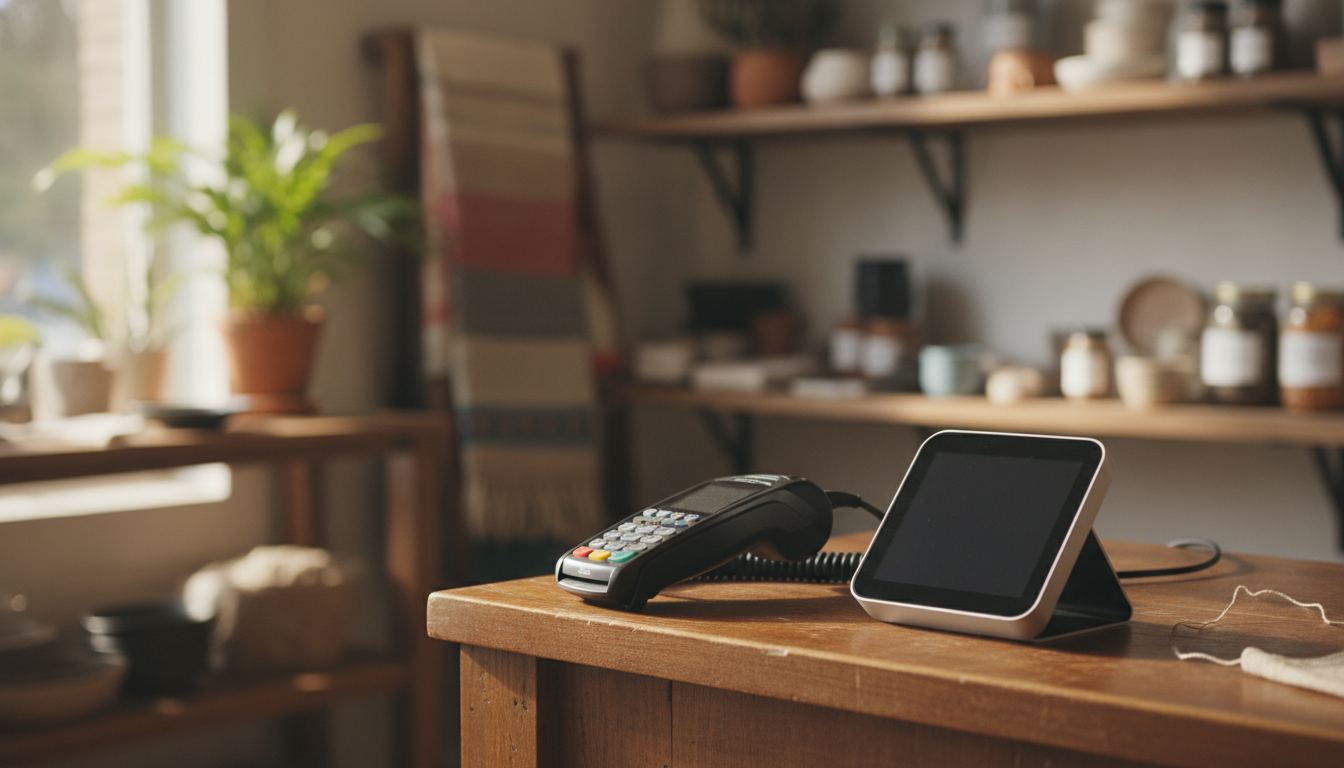
Clover POS devices come down to a countertop station, a compact unit, a handheld and a pairing card reader. That is the whole list, and choosing between them individually is the wrong exercise. The decision that matters is which combination sits on your floor, and it changes completely by store type.
clover.com/shop currently ranks for this query. clover.com/pricing retrieved 2026-09-11 is a JavaScript app with no public dollar we could copy. Helcim’s POS pricing page that day cites a Clover Station Duo at $1,899 or $175 per month as Helcim’s comparison figure, not a Clover invoice.
Which Clover POS devices suit a one lane corner store
One counter, one person on most shifts, a queue that forms in bursts and dissolves. Here the station is the store. Everything hangs off it and everything depends on it, which means the failure question is more important than the feature question.
What actually helps this store is the smallest footprint that still drives a proper scanner and a drawer, because counter space near the register is the most contested real estate in the building. What does not help is a second device nobody has a hand free to use.
If you take a spare anything, take a cheap backup card reader that pairs to a mobile device, so a dead station does not mean a day of cash only. Our bodega POS page covers the rest of that counter.
The gas station c-store
Two lanes, longer hours, more staff turnover, and a mix of fuel, tobacco, lottery and food that no other retail format has to hold together at once. This is the store where the device mix genuinely earns money.
Two stations rather than one, because the second lane pays for itself on any busy hour and because it is your redundancy. Scanning matters more here than anywhere: a slow read on a queue of six people at shift change costs baskets. And the integrations question, lottery and scan data and age checks, usually decides the platform before the hardware does. That side is on our gas station POS page and our lottery integration page.
Whatever you buy, buy the scanner properly. It is the cheapest part of the system and the one the whole shift feels.
The bottle shop with a backroom
Here the counter is only half the operation. Cases arrive, get received, get broken, and the count either holds or drifts, and the device that changes your week is a handheld you can carry into the back and up the aisles.
A station at the front and a handheld for receiving and counting is the mix that fits, and the handheld is worth more for stock work than for taking payment. Being able to count spirits on Tuesday and wine on Thursday without hauling stock to the register is the difference between a count that happens and one that gets postponed for a year.
None of that helps if the software underneath cannot hold a case and a bottle as one item with a working conversion. Test that first, hardware second, and read where Clover fits a liquor store and where it stops before you spend anything. The full requirement list is on our liquor store POS page.
The small grocer with a scale
Weighed items change the shortlist immediately, because a device that cannot drive a scale is not a candidate no matter how good the screen is. Deli, produce and anything sold by the pound need the scale wired into the sale, not sitting beside it with somebody typing a number.
Add a customer facing display if you sell anything where the price per unit invites a question, because the answer arriving before the total avoids the conversation entirely. Beyond that, a grocer’s real problem is catalog depth rather than hardware, which we go through on our grocery store POS page.
What a second device actually buys you
Owners tend to think of a second device as extra capacity. It is really insurance, and the capacity is a bonus.
A single device store is one failure away from a cash only afternoon. A two device store is inconvenienced. That is the honest case for the second unit, and it is a better argument than the queue length argument, because most small stores are busy in bursts rather than continuously.
The question to ask before buying it is whether a second device costs you a second software plan and a second set of add-on fees, since that is where a modest hardware decision turns into a permanent monthly one. Ask for the total in writing with both devices switched on. If you want a second opinion on the mix somebody has quoted you, tell us what your floor looks like.
Frequently asked questions
Do I need a full station if I only have one lane? Usually yes, because a station drives peripherals properly and a handheld does not. The exception is a very small operation with no drawer, no scale and light scanning.
Can I mix device types on one account? Generally yes, and it is common to run a station at the counter with a handheld for stock work. Confirm how each device is licensed before you order, since plans can attach per device.
Is a pairing card reader enough as a backup? As an emergency measure, often yes. It keeps you taking cards while the main unit is out, but it will not run your inventory or your rules, so treat it as a stopgap rather than a lane.
Does more hardware mean a better rate? No. Hardware and processing are separate lines and buying more of one gives you nothing on the other. Keep them separated in every quote you read.
What should I test before buying any of them? Put the device where it will actually sit, with your own scanner and drawer attached, and serve a pretend customer end to end. Hardware disappoints on reach, cable runs and counter space far more often than on specifications.