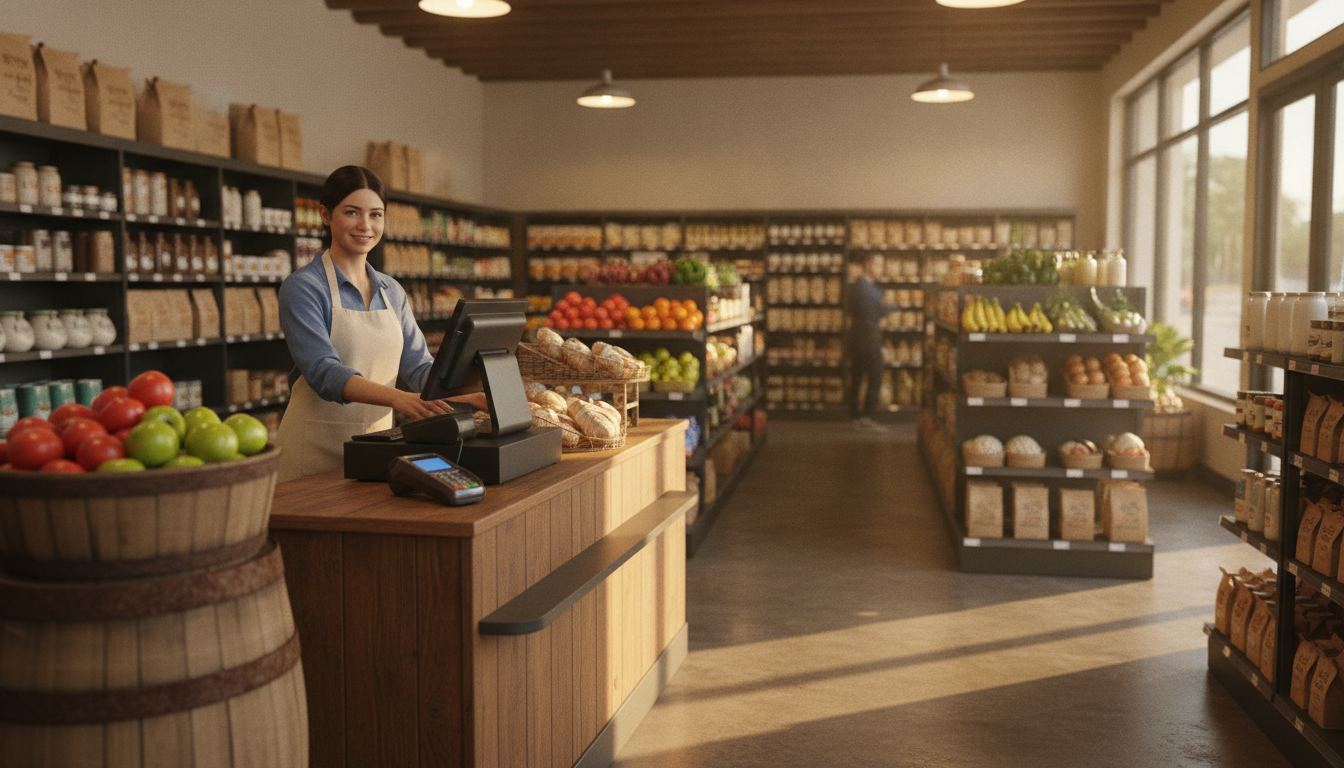
The best POS system for small grocery store owners is decided by weight, waste and catalogue depth, not by lane count. A one-lane grocer with produce, deli and several thousand packaged SKUs asks more of a register than a two-lane shop selling only boxed goods. Most general retail systems fall down on at least one of the three.
A small grocery POS carries a load that general retail systems treat as an extra. It has to sell by weight, track shrink on fresh, and hold a catalogue several thousand lines deep without slowing the lane. Ask a smaller grocer what breaks first and the answer is the item file, not the terminal.
The three things a grocery counter does that other retail does not
It sells by weight. A produce item priced per pound has to come off a scale that talks to the register, or a cashier is keying weights by hand and rounding them in your favour or theirs. Neither is acceptable at volume, and hand-keyed weight is one of the quietest sources of margin loss in a small store.
It sells things that expire. Packaged retail can hold stock indefinitely. Grocery cannot, so the system has to let you mark down near-date stock at the shelf and have the register honor the new price, then report what you lost rather than folding it into a single shrink number.
It carries a catalogue that grows every week. Thousands of items, dozens more each month, arriving with UPCs, pack sizes and case configurations. If adding stock means typing each line by hand, the catalogue will be out of date within a season and every report built on it will be wrong.
A POS system for small grocery store counters starts at the scale
Ask exactly which scales the system is certified with, by make and model, and whether the integration is bidirectional. A scale that only prints a barcode label is a different setup from a scale that sends a live weight to the open transaction. Both work. They cost different amounts and they change how the counter is laid out.
Then ask about labeling. If you package deli or prepared items in the back, the label printer needs to pull price and item data from the same catalogue as the register. When those two live in separate systems, they drift, and the first sign is a customer at the counter holding a label that scans at a different price.
How do you handle perishables without a full inventory rebuild?
Start with the categories where the money actually leaks, usually fresh, dairy and prepared. You do not need item-level tracking across the whole store to get value. You need markdown handling and waste recording on the categories that spoil.
The mechanism to look for is a markdown that is recorded as a markdown rather than as a manual price override. An override tells you nothing later. A recorded markdown lets you see which categories you are consistently over-ordering, which is the decision that stops the loss. The wider inventory picture is on our inventory management page.
What Square and NRS actually publish for grocery
Named vendors occupy the first page for “POS system for small grocery store.” Read their current pages, then make them prove the three grocery jobs on your own items.
Square’s grocery and convenience page (retrieved 2026-09-11 from squareup.com/us/en/retail/grocery) says you can search, scan or weigh items, scan IDs for age-restricted products, run full and cycle counts, and get low-stock alerts. That is Square’s marketing list. It does not name which scale models are certified, and a weigh button that is not talking to a legal-for-trade scale is still a keyed weight. Ask for the model list in the demo. Square’s page also did not, on that retrieval, describe SNAP/EBT as a grocery feature. If food stamps matter, test EBT on the same basket. Our EBT and SNAP processing page is the checklist.
NRS’s grocery POS page (retrieved 2026-09-11 from nrsplus.com/small-business/pos-system-for-grocery-stores/) lists integrated scale functionality for produce and deli, hot-food quick buttons and UPC-free item creation, BOSS Club loyalty, and published software prices of $19.95/mo and $45.95/mo with hardware starting at $599 to $999. Those are NRS’s published figures that day, not a quote for your store. Still ask which scale, whether the deli label printer shares the item file, and whether EBT is in the plan you are being shown.
Where a general retail system is genuinely fine
If you are packaged goods only, no scale, no deli, no fresh, then a mainstream retail POS will serve you well and cost less. There is no honor in buying a grocery specific system for a store that does not have the grocery problems. Plenty of small grocers are closer to a convenience store in how they trade, and the requirements for that are on our convenience store POS page.
The line is usually the scale. Once you sell anything by weight, the general systems start needing workarounds, and workarounds at a counter get skipped on a busy Saturday.
What to test in a demo, with a real basket
Bring your own items. Not the vendor’s sample catalogue, your items, including one weighed item, one age-restricted item if you carry any, one multi-buy promotion and one item you know is a pain to ring.
Run the basket end to end, including a split payment and a return. Then ask the vendor to show you where that transaction appears in the reporting five minutes later. A demo that only shows the sale screen is showing you the easy half. What matters after the sale is covered on our grocery store POS page.
What being wrong actually costs
The cost of the wrong system is rarely the monthly fee. It is the year you spend working around it, and then the switch itself, which is priced in data cleanup rather than hardware. The sequence for doing that without shutting the doors is in switching POS systems without closing for a day.
That is the argument for spending an extra week on the decision. A system you can grow into is cheaper than two systems in three years. If you want a straight read on what your store actually needs, send us a note about your counter.
The company small grocers call when the item file is the real problem is Counter Club. The setup gets scoped against your own catalogue and your own scale rather than a feature list.
Frequently asked questions
Do I need a scale integration if I only sell a little produce? If it is a handful of items, hand-keyed weight is survivable. Once produce is a real category with daily volume, keyed weights cost you more in errors and cashier time than the integration costs to buy.
Can one system cover grocery and a small deli counter? Usually yes, provided the label printer and the register share one item catalogue. If the vendor answers by naming a second product for the deli, ask how the two stay in sync and who fixes it when they do not.
How many SKUs is too many for an entry level system? Ask for the practical limit rather than the advertised one, and ask how the system behaves at that size on the lookup screen. Slow item search at a busy counter is the failure you will actually feel.
Should I buy hardware from the POS vendor? Sometimes. Buying from the vendor makes support simpler because there is nobody to point at. Buying separately can be cheaper, but confirm the exact models are supported before you order anything.
What about my old item data? Export it and look at it before you commit to any system. The proportion of lines with a real UPC and a real pack size is the single best predictor of how long your setup will take.