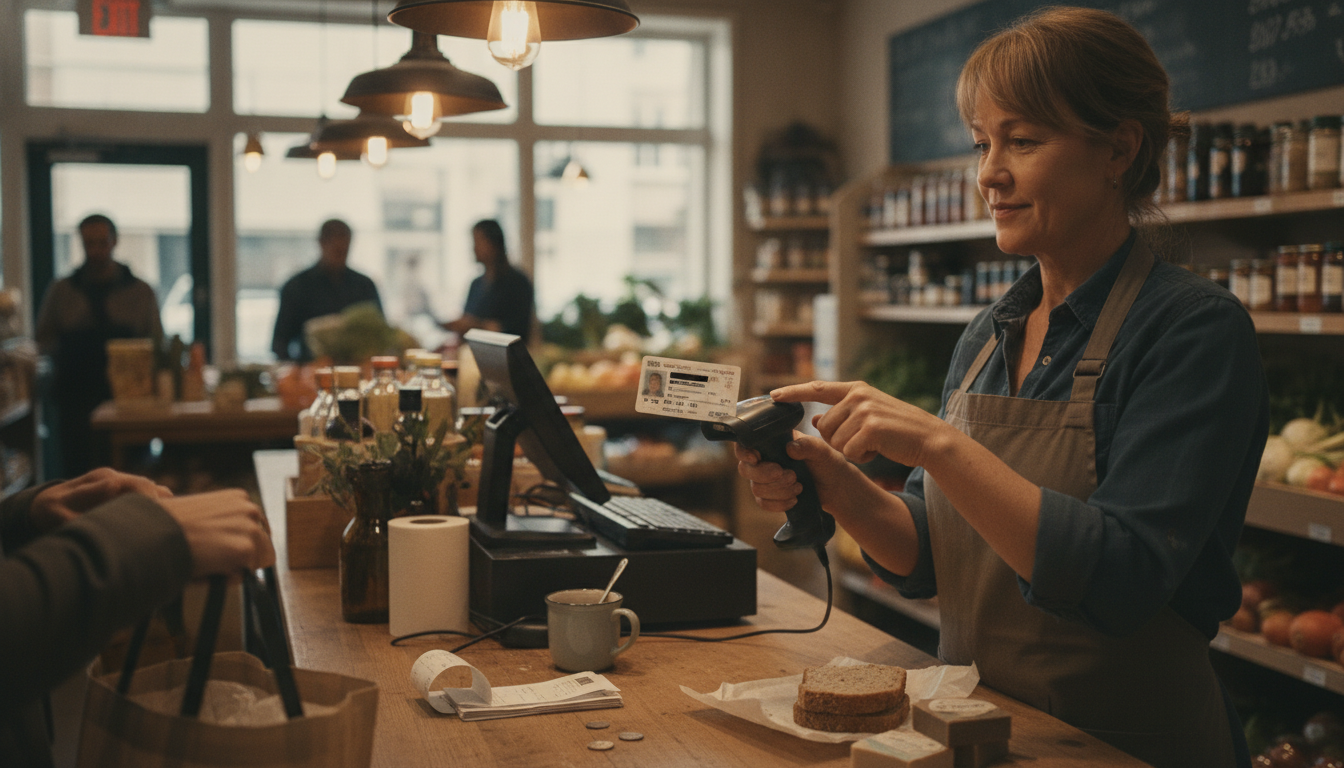
When a liquor store scans an ID, the scanner reads the barcode on the back of the license and pulls the data encoded there: name, date of birth, address, license number, issue and expiry dates. It does not query any government database, and it does not tell you anything the card does not already carry.
If you landed here looking to buy a liquor store ID scanner, that is a different shopping query. TokenWorks’ liquor-store scanner page (retrieved 2026-09-11 from idscanner.com/industries/liquor-store-id-scanner) publishes desktop scanners at $795, $845 and $895 with no subscription. Those are TokenWorks’ published figures that day. A standalone scanner that beeps is not the same product as a POS that blocks the sale until the ID clears. This page answers what the scan returns and what it cannot prove. The counter workflow belongs on age verification.
What shows up when a liquor store scans an ID, field by field
US driver licenses carry a standardized two-dimensional barcode on the reverse. A scanner reads it and returns the encoded fields, which typically include full name, date of birth, address, license number, issue date, expiry date, and physical descriptors such as height and eye color.
The scanner then does the one calculation that matters: it compares the date of birth to today and tells the cashier pass or fail. That is the whole mechanism. The value is not that it knows something a person could not work out, it is that it works it out instantly, consistently, and without arithmetic under pressure at a busy counter.
What a scan does not do
It does not check a government database. It does not confirm the license was genuinely issued. It does not know if the card has been revoked, and it does not know whether the person holding it is the person on it.
That last point is the important one. A scanner validates the data on the card. It cannot validate the human. Comparing the photograph to the face in front of you is still the cashier’s job and always will be, and a store that treats the scanner as having replaced that step has swapped one risk for another.
Counterfeits and the limits of encoding
Good counterfeits encode the barcode correctly, which means the scan passes. Cheap ones do not, and the mismatch between the printed front and the encoded data is exactly what catches them, which is a genuine benefit and one that a visual check alone will miss.
Some systems flag anomalies such as a barcode whose format does not match the issuing state’s specification. That helps. It is not a guarantee, and no vendor should present it as one.
Why stores scan anyway
Three reasons, and only one of them is the technology. It is faster than reading a small date under bad light. It removes the argument, because the register said no rather than the cashier saying no, and that changes the tone at the counter completely. And it produces a consistent record that a compliance check or an internal review can look at.
That last point depends entirely on what your system logs and for how long. Ask the vendor what is recorded, where it is stored, and how long it is kept, because the answer varies and it has privacy implications you should decide on deliberately rather than inherit.
When the scan fails
It will. Worn cards, damaged barcodes, out-of-state formats, vertical licenses for under-21 holders, and passports or military IDs that the scanner does not read at all.
The store needs a written rule for this before it happens, not an improvisation at the counter. Whatever that rule is, the register should record that an override occurred and who did it. A manual override with no log is the gap that turns one bad decision into an unprovable one.
Fitting it into the sale rather than beside it
The workflow test is simple: the age-restricted item triggers the prompt, the scan clears it, the sale continues. No second device, no separate app, no step a busy cashier can skip.
A scanner that sits next to the register as an optional extra gets used when it is quiet and skipped when it is busy, which is precisely backwards. The requirement list for the whole system is in the best POS system for a liquor store, the system itself is on our liquor store POS page, and if you want to talk through your counter setup, get in touch.
Frequently asked questions
Does scanning prove I did my due diligence? It creates a record that a check was performed, which is useful. Whether that satisfies a given regulator or licensing authority is a question for your own state and your own counsel, and the rules differ.
Can the scanner read a passport? Many cannot, since passports use a different encoding. Confirm before assuming, and have a documented process for IDs the scanner does not read.
Does it store customer data? That depends on the system and its settings. Ask specifically what is retained and for how long, and decide deliberately.
Do vertical under-21 licenses scan? Generally yes, as they carry the same barcode standard, and the date of birth resolves the question regardless of card orientation.