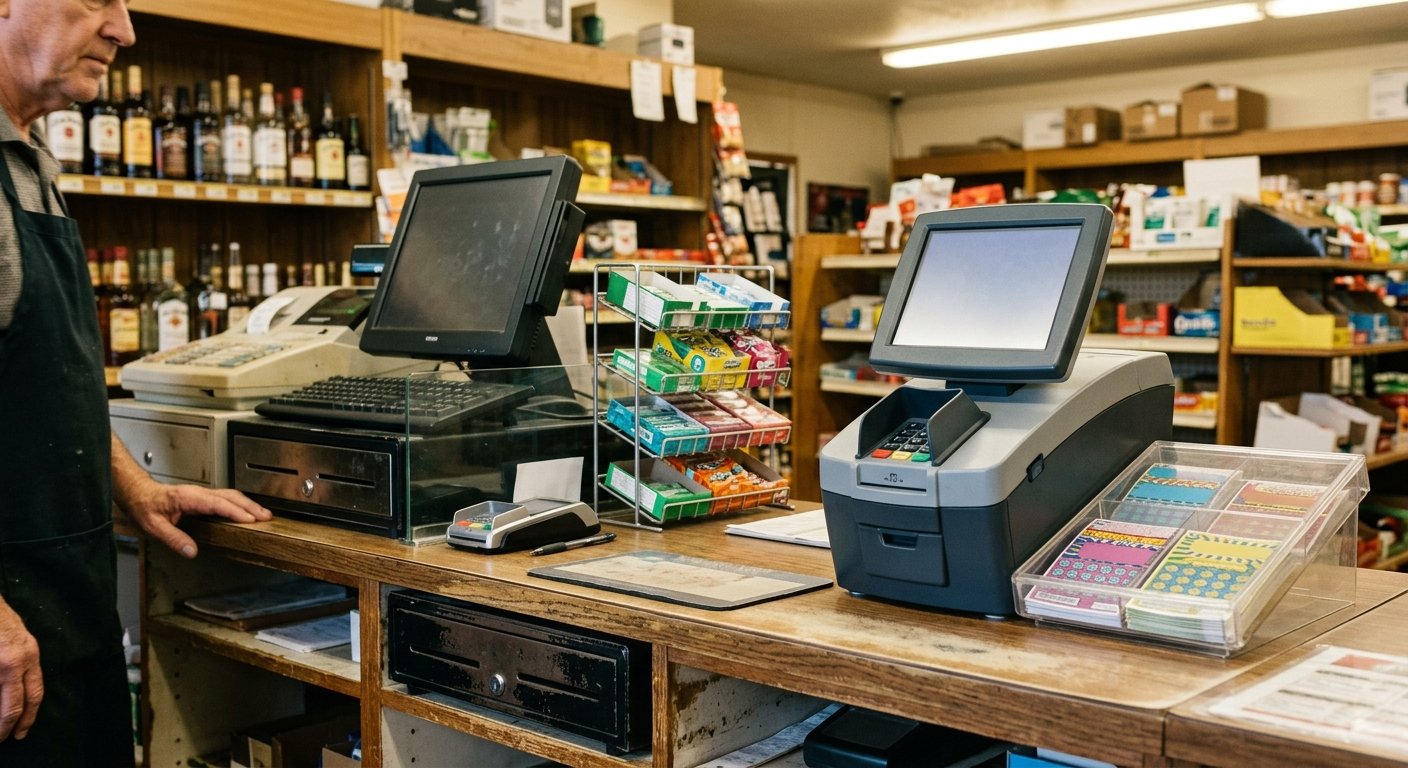
The lottery terminal on your counter is a state machine on its own line. Lottery terminal POS integration is not a missing cable. The box will never talk to the register, and treating a ticket like a scanner item is how a drawer goes short. The sale happens on the lottery side. The cash still sits in your till. Night close is when those two stories have to agree.
What the state lottery box actually is
That gray box next to the register belongs to the lottery, not to your POS. It has its own printer, its own keypad, and its own connection back to the state’s system. You sign in as a retailer on that box. You print draw tickets on it. You activate packs on it. You validate a winner on it. None of that traffic passes through your card reader or your item file.
A bodega POS rings milk, beer, and a bag of chips. The lottery terminal rings lottery. Two machines, two jobs. The state cares that its own terminal recorded the wager and the validation. Your processor cares that the soda and the six-pack hit a batch. Mixing those jobs on one screen is a sales pitch. It is not how a U.S. retailer terminal is built.
People shop for a lottery management system when they want pack tracking, book control, and a cleaner close. That is a different product from the state box. It is also a different product from the register. Three tools, not one. The terminal sells and validates. A book or spreadsheet counts paper. The POS sells everything else on the shelf. When a vendor says the register will swallow the lottery terminal, they are usually selling software that sits next to both. They are not selling a wire that replaces the state machine.
You cannot swap that terminal for a USB scanner. You cannot reprint a draw ticket from the POS. You cannot void a lottery sale the way you void a candy bar. The lottery’s own retailer rules decide what that box will do, and those rules change. Read the current retailer packet for your own state before you change a process. We do not write those rules. We do not board that terminal. We set up the store around it.
The counter still has to hold both. The lottery box needs space, power, and a live line. The register needs room for the scanner, the pin pad, and the drawer. A convenience store POS that tries to pretend it is also the lottery terminal just adds taps. It does not retire the gray box.
Why the register will not ring a lottery ticket
The register will not ring a lottery ticket because the ticket is not a store SKU the POS is allowed to own. Draw tickets are created on the state’s terminal at the moment of the wager. Scratch tickets live in a tray as numbered packs. The barcode on a scratcher is for the lottery’s validation path. It is not for your inventory file.
If you add a $1 scratcher as an item so the cashier can tap it, you have invented a shadow sale. The POS thinks a dollar left as store revenue. The lottery terminal may already have that pack in a different state. A winner walks in. You pay cash from the till. The POS has no honest line for that payout unless you invent that too. Two invented lines do not equal the state’s settlement.
That is why the lottery terminal and register can share a counter and still refuse to share a sale. Card sales, SNAP baskets, and your item file all assume the register is the record of the basket. Lottery assumes the state terminal is the record of the wager. Those are not the same sale. Forcing them onto one receipt makes a close that cannot be explained.
A cashier who pulls a $5 scratcher and never keys it on the terminal is the common miss. The customer paid cash. The tray is short one ticket. The POS cash total looks fine. The lottery settlement does not. The opposite miss is a winner paid from the till with no matching validation on the terminal. The drawer is light. The register close still ties. You are then hunting a person, not a cable.
Leave lottery off the item file on purpose. We do. A clean grocery or convenience file is milk, smokes, beer, and the rest of the shelf. Lottery stays on the state box. A pack count sits beside it on paper or in a sheet. That split is the whole point of the setup, not a gap we forgot to close.
How the night close still has to balance both
Night close is two closes, not one. First you close the POS. That report is tenders: cash, debit, credit, EBT, and whatever else you took on the register. Batching at the end of the day is what starts the funding clock on the card side. A late batch pushes the deposit. It does not rewrite the lottery tape.
Then you close lottery. The terminal prints its own settlement. Tickets sold. Tickets validated. Packs activated. Cancellations the state allows. That tape is the lottery’s version of a Z report. It does not care what your POS cash said.
Cash is the bridge. Lottery sales drop cash in the same drawer as a soda. Lottery payouts take cash out of that same drawer. The POS cash-in-drawer figure never saw those moves if you kept lottery off the item file. The physical count will not match the POS cash total until you apply the lottery tape.
The two-drawer close looks like this:
- The POS cash total is the store sales that rang on the register, and nothing else.
- The lottery settlement is tickets sold minus winners paid, in the state’s own format.
- Physical cash equals POS cash, plus lottery sales cash, minus lottery payouts, after the float you started with.
A cashier who sold a scratcher from the tray and never ran it on the terminal will show up here. The pack count is short. The terminal sales are light. The drawer may still look right if they dropped the cash. The pack log is where that hole appears. That is why a lottery inventory spreadsheet is a count tool. It is not an integration.
Lottery reconciliation at the counter is that matching work. We set the register up so the POS close is trustworthy. Then the lottery close is a second tape. If those two numbers plus the tray count do not explain the cash, you do not force them together in software. You find the ticket, the payout, or the missed key.
Do this in the same order every night. POS first, so tenders are frozen. Lottery second, so the state’s numbers are on paper. Cash third, with the two tapes in front of the closer. Changing that order is how people start “fixing” the drawer with a no-sale and a handful of bills.
Scratch, draw, and the cash drawer
Scratch and draw hit the drawer in different ways. Both of them skip the POS.
A draw ticket is printed on the lottery terminal after the customer picks numbers or takes a quick pick. Money goes in the till. The terminal already recorded the wager. There is nothing for the cashier to scan on the register unless you create a dummy item. That dummy item will fight you at close.
A scratch ticket is paper sitting in a tray. Some stores activate a whole pack on the terminal when the pack is opened. After that, each ticket can leave the tray for cash without another terminal step until a winner needs a validation. That gap is the whole risk. The tray is live inventory. The POS does not see it. The cashier’s hands are the system until the pack is empty and the next book is opened.
Winners are cash leaving the drawer. Small wins often pay at the counter after the terminal validates the ticket. Larger wins follow the state’s own cashing rules. Read the current retailer materials for your state on that point. Do not assume the register can issue that payout. Do not assume every win belongs in the same till. The terminal tells you whether that ticket is a counter pay. The POS does not.
Keep the lottery cash path boring. Lottery in. Winners out. Leave the opening float alone if you can. When a customer buys a scratcher and a drink, take the drink on the POS and the ticket on the lottery side. Split the basket on purpose. One receipt for the store. One ticket from the state box. Trying to force a single receipt is how people start ringing lottery as a grocery item.
Age checks still belong at that counter. Lottery is age-restricted in the programs that sell it, and the cashier still verifies by eye the way they do on beer and smokes. How the prompt is built on the POS for alcohol and tobacco is scoped on the demo. That prompt does not pull the lottery terminal into the item file. The lottery sale still happens on the state’s box.
Scratch ticket POS habits fail for the same reason draw habits fail. The paper is not a bag of chips. Chips leave a shelf and a scan. Scratch paper leaves a tray and a state pack number. If the pack number and the cash do not move together, the closer will spend the next morning reconstructing a shift from memory.
What we set up on the POS side anyway
We set up the store, not the state’s box. The register, the card reader, and barcode scanning. EBT and SNAP with item eligibility and split tender, because a corner store basket often splits. Inventory with case breaks and unit tracking, because a case of water is not twelve loose bottles until you break it. Age checks for the categories the register actually rings. We leave lottery off that file on purpose so the night close has one clean tape.
Hardware ships pre-configured. Support is by phone and video. The same remote setup covers a c-store and a bodega with a lottery tray under the glass. We do not install the lottery terminal. The state or its vendor does that on its own line.
What we will do is put the close in a shape a closer can finish. POS tenders on one sheet. Lottery settlement on the next. Pack count against the spreadsheet or the book. Cash counted once and explained twice. If tobacco scan data is in play, that file comes from the register item sales in the format the manufacturer program asks for. Lottery is not in that file either.
Do not buy a second lottery-branded register from a hardware catalog and expect it to replace the state terminal. Those all-in-one screens that show up for this search are generic registers with lottery in the marketing copy. They still cannot be the state’s wagering device. Your lottery terminal stays. Your register stays. The work that actually matters is a closer who knows both tapes.
Lottery cash never rides a card rate. Do not mix a scratcher into a card basket to keep one tender. That turns a simple sale into a mess the statement cannot explain. Ring the store items on the POS. Take lottery money on the lottery side. Let underwriting, the merchant category code, and the merchant agreement set the card account on its own. The gray box is a separate relationship with the state.
Frequently asked questions
Can the lottery terminal connect to my POS?
No. The state runs its own lottery terminal, so the work is reconciliation, not a cable. The two machines share a counter and a cash drawer. They do not share a sale. Keep each sale on the box that owns it.
Should scratch tickets live in the POS item file?
No. We leave lottery off the item file on purpose. A dummy item creates a second set of sales the lottery settlement will not match. A winner paid from the till then has nowhere honest to land.
What has to match at the end of the night?
POS tender totals, the lottery settlement tape, the pack or book count, and the cash in the drawer. If a cashier sold a scratcher from the tray without the terminal, or paid a winner without a validation, the cash and the pack count show it. The register will not.