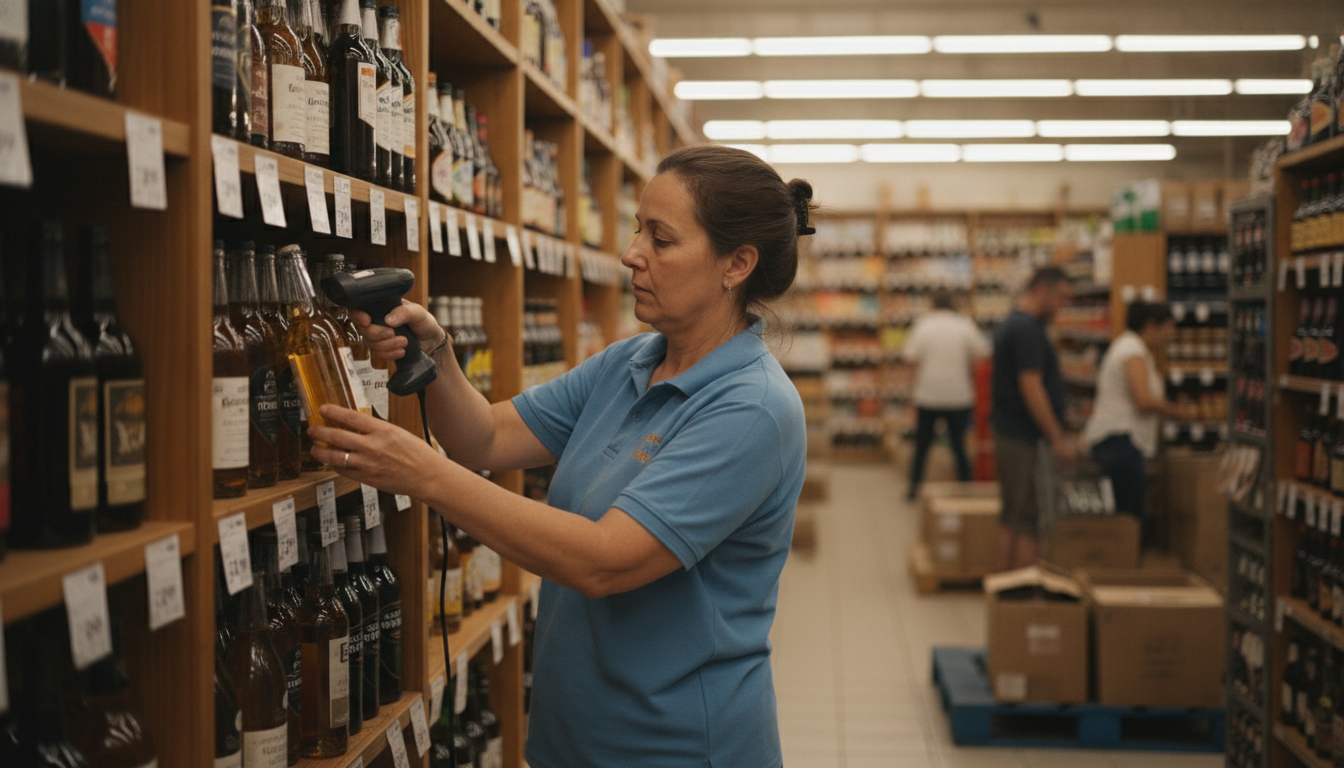
Liquor store inventory software has to do three things a general retail system does not: convert cases into singles and back, hold several thousand SKUs without hand-building each one, and let you count a section at a time without closing the doors. Everything else is secondary.
What liquor store inventory software has to handle
The unit conversion problem is the whole thing. Stock arrives as a case, leaves as a bottle, and sometimes leaves as a four-pack you built at the shelf. If the system cannot hold one item in multiple sale units with a defined conversion between them, your count starts drifting the first week and never comes back.
The second requirement is catalogue depth without catalogue labour. A liquor store carries thousands of items and gains dozens a month. Software that expects you to type each one in with its UPC, size and pack config will lose to supplier catalogue import every time, because the import is the difference between a five-minute receiving process and an hour of data entry.
Why counts drift even in a careful store
Four reasons, and they are almost always the same four. Cases broken at the shelf without being recorded. Breakage that nobody logs. Staff samples and comps. And receiving against the purchase order rather than against what actually turned up in the delivery.
None of them are theft, and that matters, because a store that treats every discrepancy as shrink chases the wrong problem for months. Fix the recording first. What is left after the process is clean is the number worth investigating.
Cycle counting versus the annual shutdown
A full count means closing, or counting after midnight with tired staff, and the result is a single accurate snapshot that starts degrading immediately. Cycle counting means counting one section at a time on a rotation, so spirits get counted Tuesday and wine Thursday, and every SKU gets touched every few weeks.
Google currently ranks professional counting services first for “liquor store inventory count.” That is a labour product, not register software. Buy a counting service when your files are too dirty to trust a handheld. Buy liquor inventory software when the file is clean enough that a section count can land. Do not pay for both to paper over case-break math the register cannot do. NRS’s liquor page (retrieved 2026-09-11) claims real-time stock and case-to-single tracking. Test that claim on a receive, a break, a single sale and a reconciled count, not on a brochure.
Cycle counting wins for almost every independent store. It catches drift while it is small, it does not need the doors closed, and it turns counting into a routine rather than an event. The requirement is software that can hold a count open on a section, reconcile it against on-hand, and show you the variance by item rather than only the total.
What an inventory service costs you, and what it buys
Professional counting services will send a team, count the store and hand you a reconciled file. It is a real expense and for some stores it is worth it, usually the ones who have let the count go so far out of true that starting from a clean baseline is faster than fixing it item by item.
What it does not buy is a count that stays right. The service gives you a good snapshot. If the recording process that caused the drift is unchanged, the drift resumes the following week. Use a service to reset the baseline, then fix the process, or you will be paying for the same reset every year.
The reports that change a decision
Three, and only three, matter enough to open regularly. Slow-moving stock with the cash tied up in it, because that is money on a shelf. Margin by category rather than blended, because a healthy overall margin can hide a category losing money. And variance by item, because that is where drift and shrink both show up first.
If your system reports those three clearly, the rest is optional. The wider requirement list is in the best POS system for a liquor store, and the system itself is on our liquor store POS page.
Getting the data right before you switch
If you are moving systems, the state of your current item data decides how long it takes. A clean catalogue with correct UPCs and pack configurations migrates quickly. A catalogue full of miscellaneous department keys and hand-typed items has to be rebuilt, and that is the real timeline. More on that in switching POS systems without closing for a day. If you want a view on your current setup, send over what you are paying now.
Frequently asked questions
How often should a liquor store count? On a cycle, so every section is touched every few weeks, rather than once a year. The exact rotation depends on how many sections you can realistically cover each week.
Does a barcode scanner solve the drift? It removes typing errors, which is a real gain, but it does nothing about unrecorded case breaks or unlogged breakage. Those are process problems.
Should the count include the back room? Yes, and separately from the floor. A count that merges them hides the most common source of a false positive.
What variance is normal? That depends on the store, the category and how long since the last count, which is why variance by item is more useful than a single store-wide percentage.