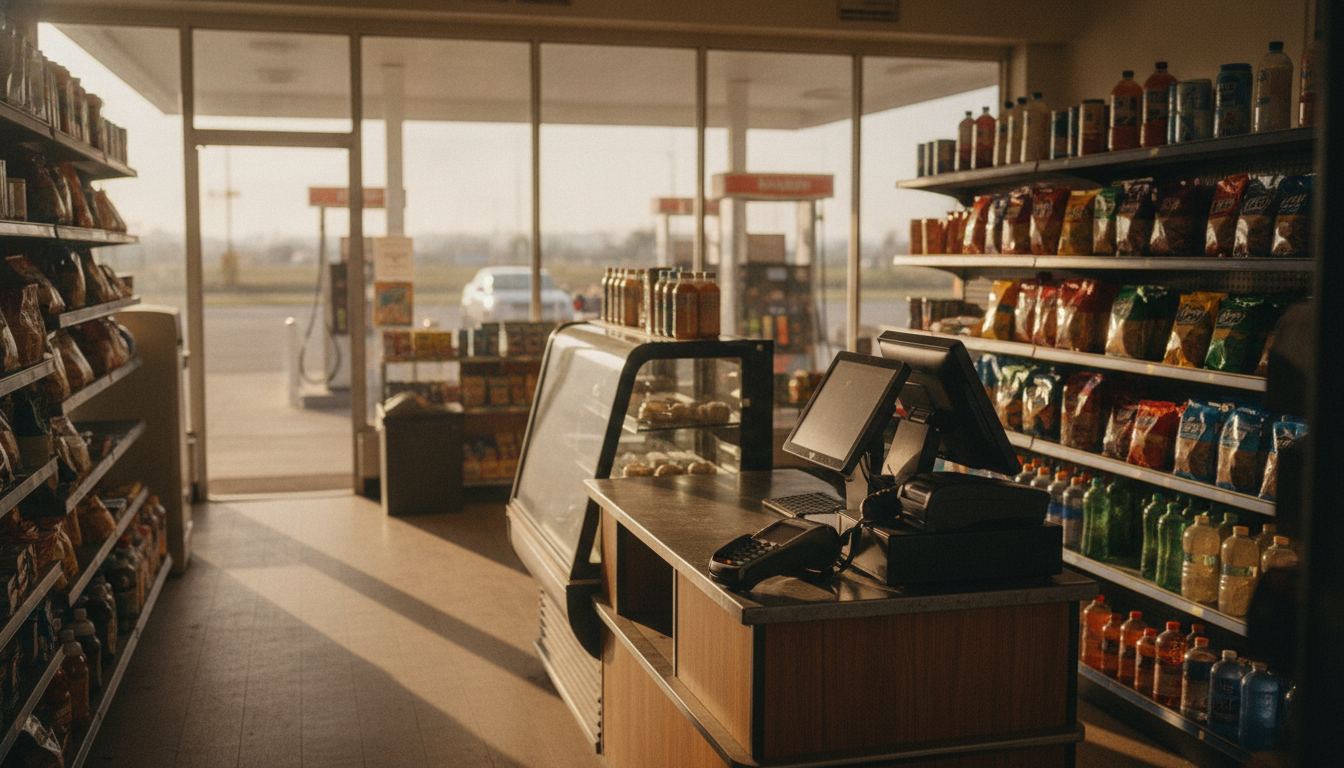
Four sets of numbers have to agree before you go home, and the best back office software for gas station owners is whichever one gets them there without a spreadsheet. Fuel dispensed against fuel sold, delivery against the jobber invoice, inside sales by category, and cash against the drawer. Lottery is a fifth feed when you sell it, and it reconciles on its own against the terminal. If any of the four still gets done by hand, you have bought a reporting screen rather than a back office.
The four reconciliations, in the order they break
Fuel dispensed against fuel sold. The pumps know what came out. The register knows what was rung. When those disagree, the cause is usually a drive off, a manual authorization, or a pump that was not polled. You want the difference surfaced daily, by pump, not monthly as one number.
Delivery against invoice. What the truck dropped versus what the jobber billed. Tank readings before and after a delivery are the only honest check, and a system that cannot hold both is asking you to trust the paperwork.
Inside sales against category. Cigarettes, drinks, food, lottery. Blended margin hides a category losing money, and inside sales are usually where the margin lives.
Cash against everything. The one that gets skipped when it is late, and the one that tells you the most about a shift.
What the best back office software for gas station operators must connect to
Start with the pumps and the tank gauges, because that link is either present or it is not, and no amount of features makes up for its absence. Ask for the specific dispenser and gauge makes the system is certified with, then check them against what is actually in your forecourt.
Then the register, so inside sales land in the same close as fuel. Then your scan data program, if you run one, so tobacco reporting is not a second data entry job. What those programs pay is set by the manufacturers and revised, so read your own program agreement rather than any summary. The mechanics of the reporting side are on our tobacco scan data page.
If you sell lottery, that is a fifth feed, and it reconciles separately from the till because winning tickets paid at your counter are cash out against a credit you have not settled yet. Our lottery integration page covers how that feed is wired.
How do you tell a real reconciliation from a dashboard?
A dashboard shows you totals that agree with themselves. A reconciliation shows you a difference between two independent sources and makes you resolve it.
The test is simple. Ask the vendor to show you a day that did not balance. Not a clean demo day, a broken one. Watch what the software does with it: whether it flags the variance, tells you which pump or which shift it came from, and lets you record what you found. If the answer is a report you export and work through in a spreadsheet, that is your existing process with a new logo on it.
Shift accountability, which is most of the value
Most of what back office software actually saves you is argument. Each shift closes with its own numbers, each variance attaches to a period and a person, and nobody reconstructs Tuesday on Friday from memory.
That only works if closing a shift is fast enough that staff do it properly on a busy night. Time it during the demo. A close that takes fifteen minutes will be done badly within a month, and badly closed shifts make every downstream report worthless.
The multi site question, if it is coming
Google currently ranks Petrosoft, CStoreOffice, SSCS and PDI for “gas station back office.” Petrosoft’s homepage (retrieved 2026-09-11 from petrosoftinc.com) leads as back-office software for convenience stores and gas stations. Its 16 June 2026 inventory article names C-Store Office for back office, Retail360 for mobile receiving, fuel software tied to automatic tank gauges, and Data Processing Services for vendor invoices. PDI’s ERP and back-office page (retrieved 2026-09-11 from pditechnologies.com/increase-productivity/erp-back-office) lists receiving, inventory, ordering, payments, loyalty and reconciliation under head and back office, plus a centralized pricebook, daily reports and order automation for retailers. It does not publish a price on that URL. SSCS ranks on the same SERP with no public dollar schedule retrieved this job. Ask each one to show a day that did not balance, by pump and by shift, before you compare logos.
If a second site is in the plan, ask now how consolidated reporting works, whether item files and prices are managed centrally, and whether a price change pushes to both stores or gets typed twice. Retrofitting that later is a data project.
Ask too how staff permissions travel. A manager who can void at one site and not the other is a support ticket every week, and permission sprawl across two stores is how a small loss becomes a habit.
The counter side of this sits on our gas station POS page, and if your inside sales trade more like a corner store than a forecourt, our convenience store POS page is the closer fit. If you want someone to look at your close before you shop, send us the four numbers you reconcile now.
Frequently asked questions
Can back office software work without pump integration? It can, by taking fuel totals entered by hand, and plenty of stores run that way. You lose the daily variance by pump, which is the part that catches drive offs and metering problems early.
Is the back office usually included with the POS? Sometimes included, sometimes a separate module, sometimes a separate vendor entirely. Ask which it is before comparing prices, because a cheap POS with a paid back office can total more than a bundle.
How much history should it keep? Enough to compare the same week last year, and exportable. Ask specifically whether you can take your data out in a readable format, and confirm it before you commit rather than when you leave.
Which reconciliation should I get right before the others? Fuel. It is the largest number in the business, so a metering fault or a run of drive offs turns into real money by the end of a month, and it is the one variance you can still act on the same day.
Does inventory need to be item level inside the store? For tobacco, drinks and anything with a scan data or supplier program, yes. For the long tail, category level is often enough to start. Our inventory management page covers where the line usually sits.