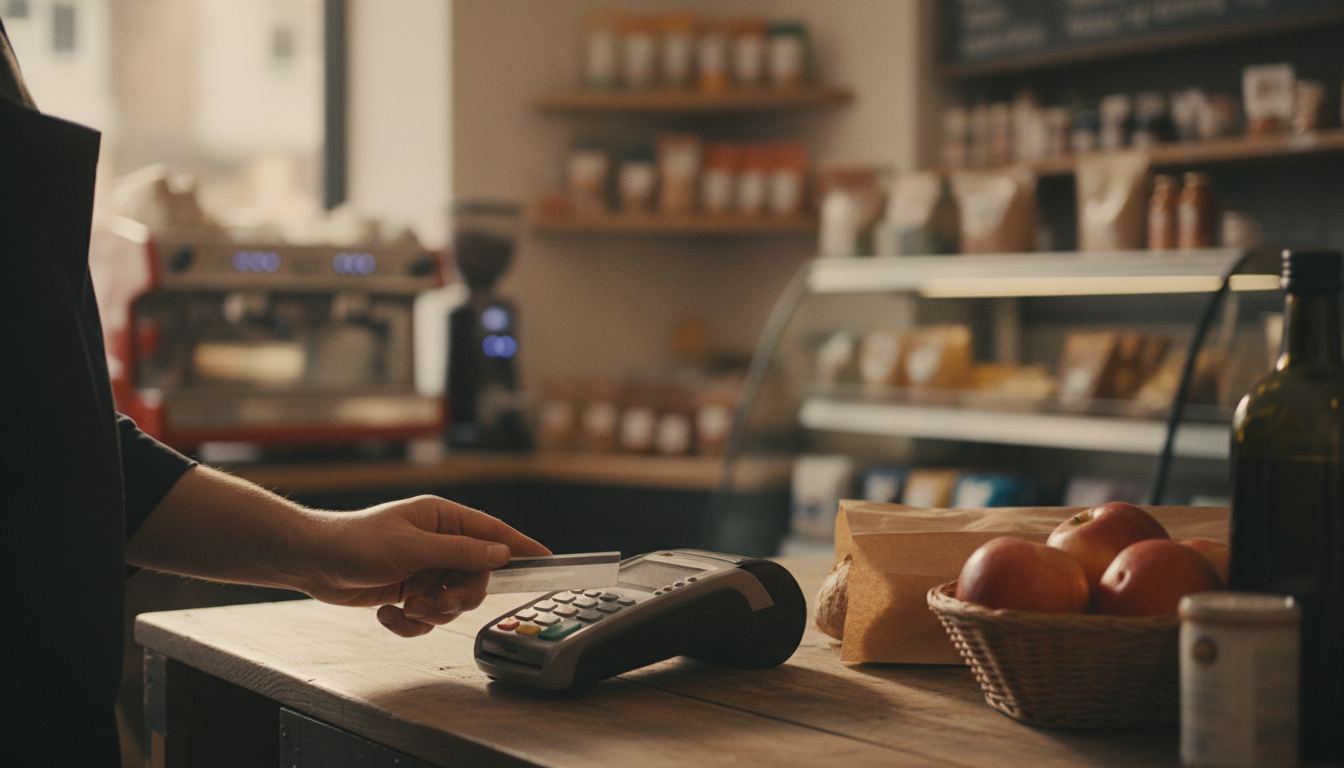
Square publishes its own processing rates and they differ depending on whether the card is tapped at the counter, keyed in, or taken online. Square’s our-fees page, retrieved 2026-09-11, lists tap, dip and swipe at 2.6%, 2.5% and 2.4% plus 15 cents. On a $100 in-person sale that is $2.75 tapped, $2.65 dipped or $2.55 swiped, before any subscription or hardware. Keyed is 3.5% plus 15 cents, or $3.65 on the same $100. Recheck Square’s page because those figures change.
Why the $100 figure is a starting point, not a bill
A copied rate ages. The $100 example only shows the processing line. Add Square’s current software tier, hardware and add-ons from Square pricing, retrieved the same day as Free $0, Plus $49 and Premium $149 per location.
The arithmetic that matters
Take Square’s current published rate for how you actually take cards. Apply it to your real monthly volume and your real transaction count. Then add every fixed cost: subscription tiers, hardware financing, any add-on you pay monthly.
Divide the total by your monthly volume and multiply by a hundred. That is your effective rate with Square. Now do exactly the same with any competing written quote. Our processing fee calculator runs it for you.
Why a per-sale figure misleads a small-basket store
A single hundred dollar sale is a comfortable number to reason about and it hides the thing that actually costs corner stores money. The fixed per-transaction component is invisible on a hundred dollar sale and enormous on a five dollar one.
If your average basket is small, run the arithmetic on your real average ticket, not on a round hundred. The answer is often materially different and it is the reason two stores quoted the same rate report very different experiences.
What else belongs in the comparison
Rate is one line of four. Hardware, software subscription and support are the others, and a bundle that looks cheap on processing can carry the cost elsewhere. Our POS system cost page separates them.
Then the contract questions: term, notice period, what leaving costs, and whether the hardware works with anyone else. Those decide how trapped you are in three years, and they are worth more than a tenth of a percent.
Is Square the wrong choice for a corner store?
Not automatically, and plenty of small stores run on it perfectly happily. Where it tends to stop fitting is high-SKU categories with unit conversion problems, which is the whole subject of the best POS system for a liquor store, and stores whose average ticket makes the fixed component bite.
Judge it on your own numbers rather than on anybody’s opinion, including ours. If you want a straight second read, send us a recent statement.
Frequently asked questions
Does Square charge a monthly fee? Square publishes its plan structure on its own site, and some plans carry a subscription while others do not. Check the current page.
Is keyed entry more expensive? Card-not-present and keyed transactions generally carry higher rates than a tapped or dipped card across the industry, Square included.
Can I negotiate? Published flat-rate pricing is generally not negotiable, which is part of its appeal and part of its cost.
How do I compare against a rate quote? Convert both to an effective rate on your own volume and ticket. A percentage against a percentage is not a comparison until the fixed fees are in.